Exporters & manufacturers
Understand the questions to address before supplying goods to customers in Central Asia and the Caucasus.
A practical guide to export regulations, product classification, compliance, conformity, transport and customs for companies trading with Central Asia and the Caucasus.
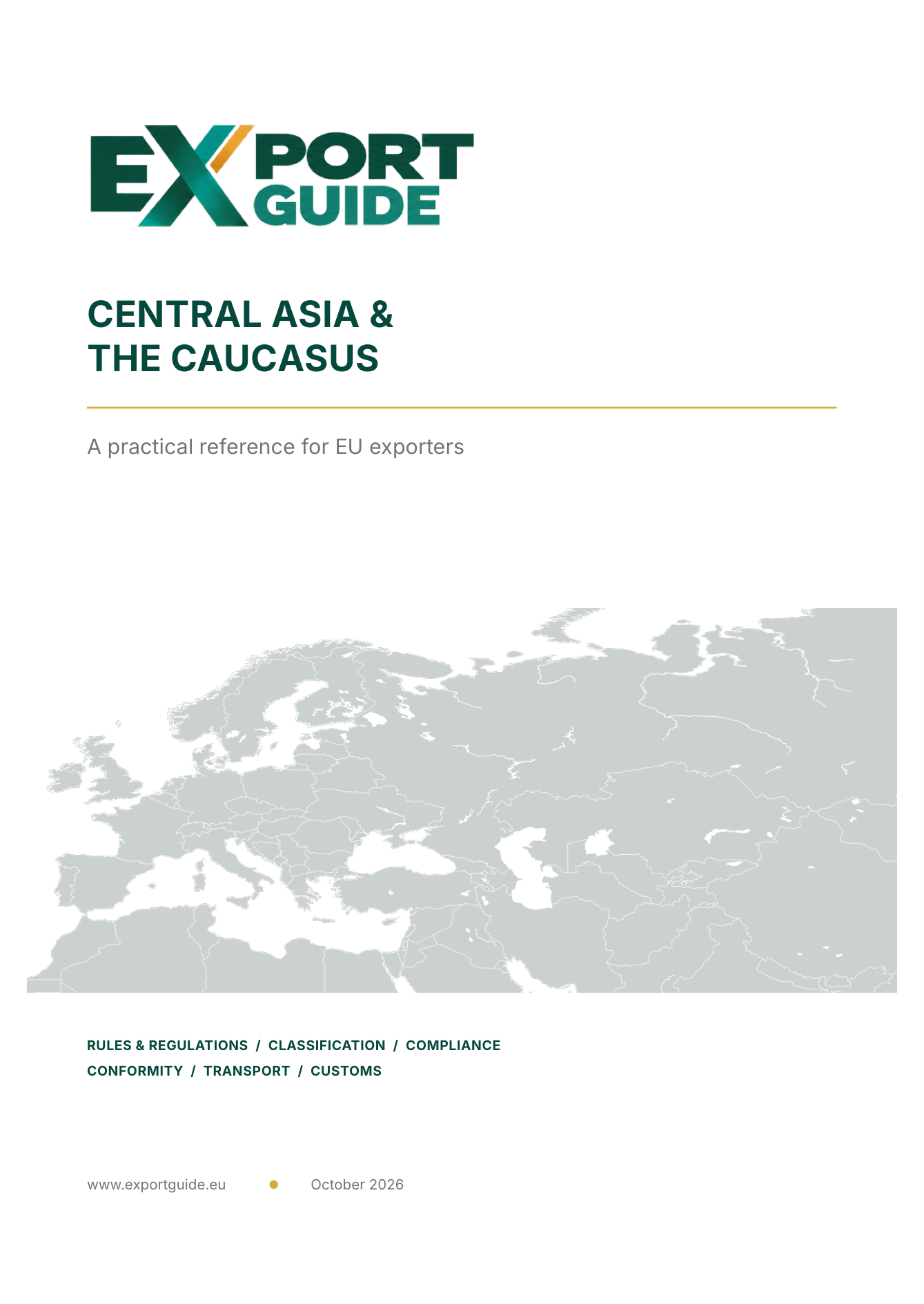
EXPORT GUIDE explains key export compliance requirements, customs documents and product classification for businesses trading with Central Asia and the Caucasus.
Whether you are preparing your first shipment or reviewing an established export process, this guide provides a structured starting point. It is intended as practical reference material, not a substitute for legal advice on a particular transaction.
Understand the questions to address before supplying goods to customers in Central Asia and the Caucasus.
Organise checks relating to product classification, restrictions, sanctions and documentation.
Review transport, customs clearance and the documents commonly needed to move goods.
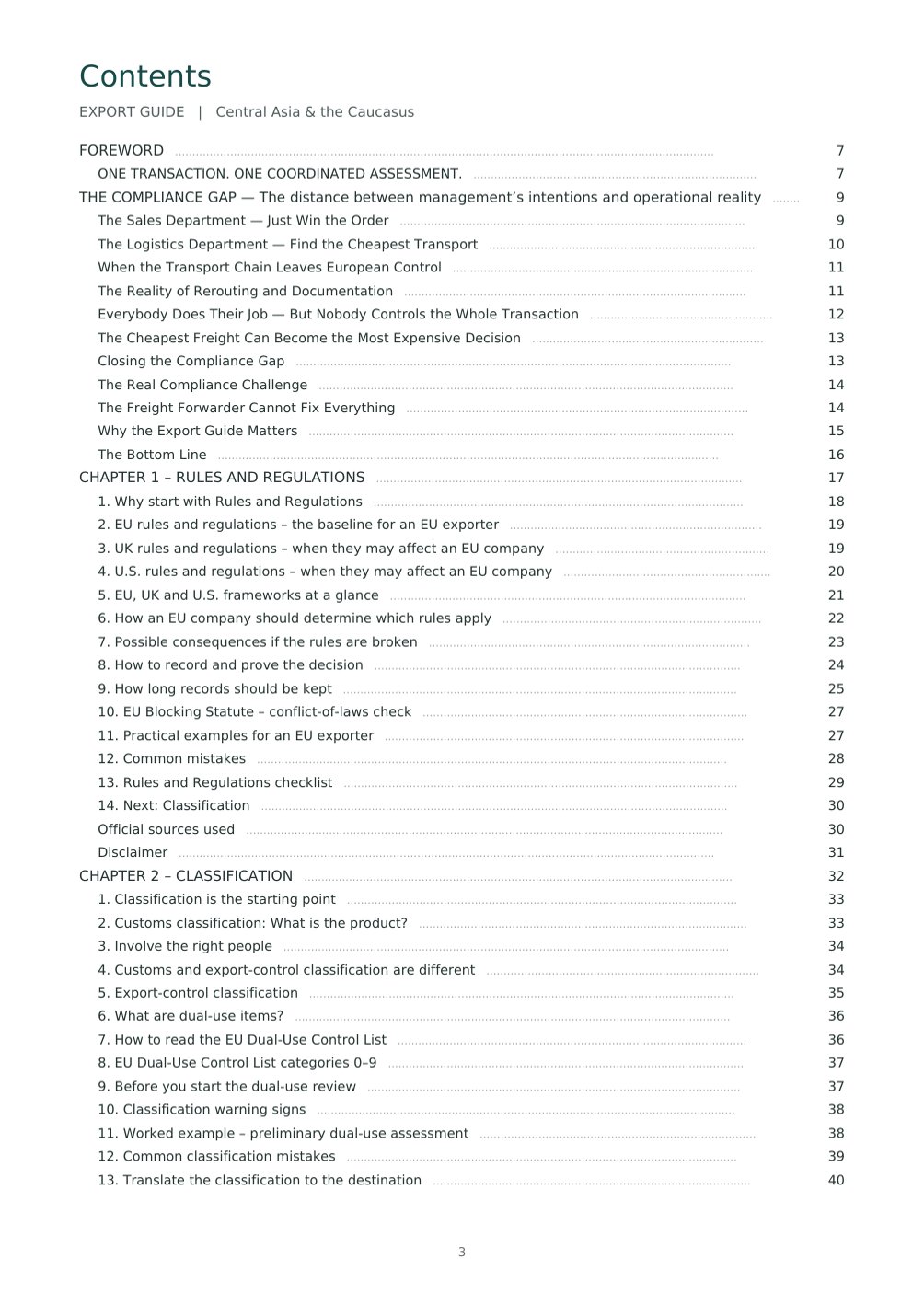
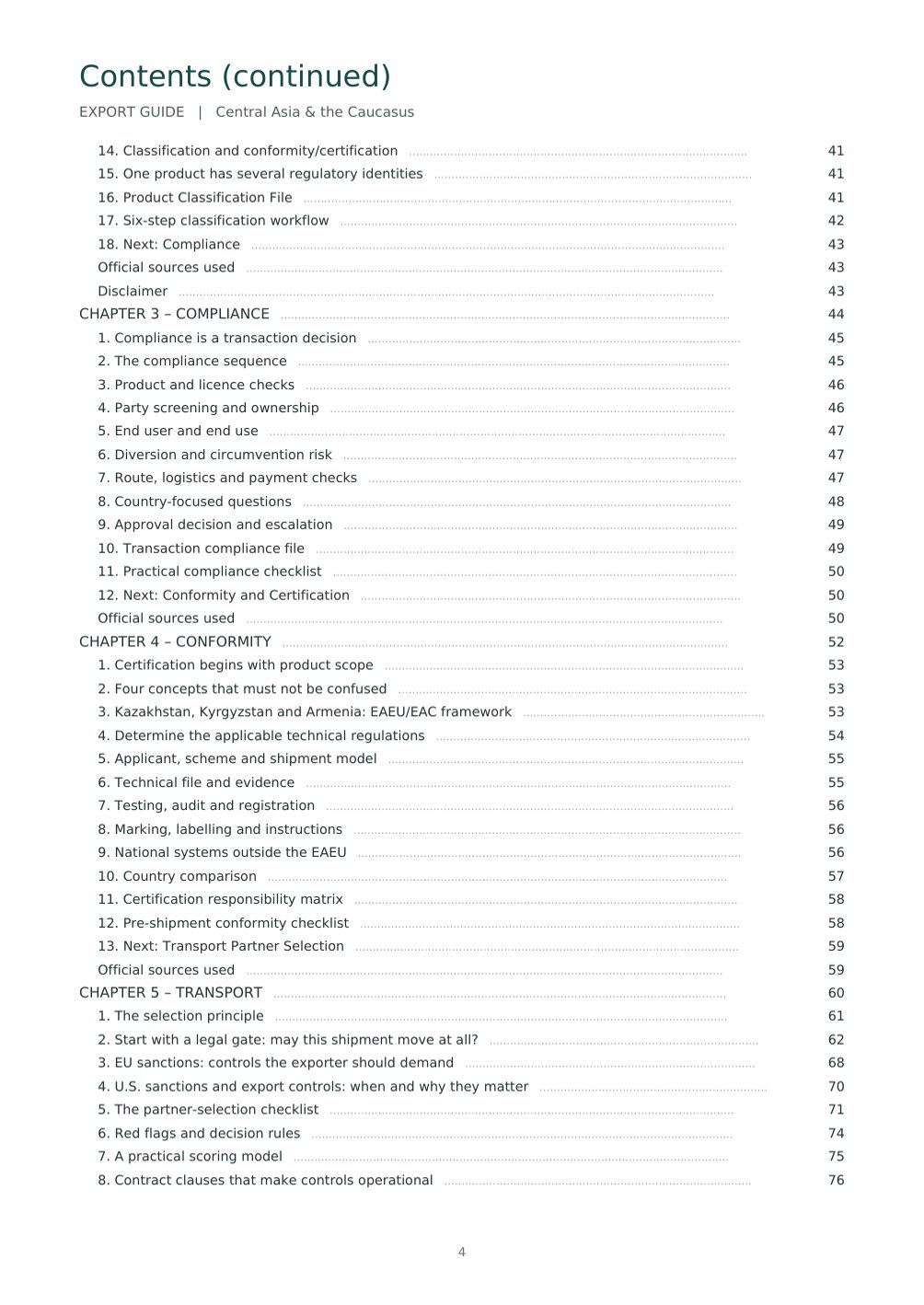
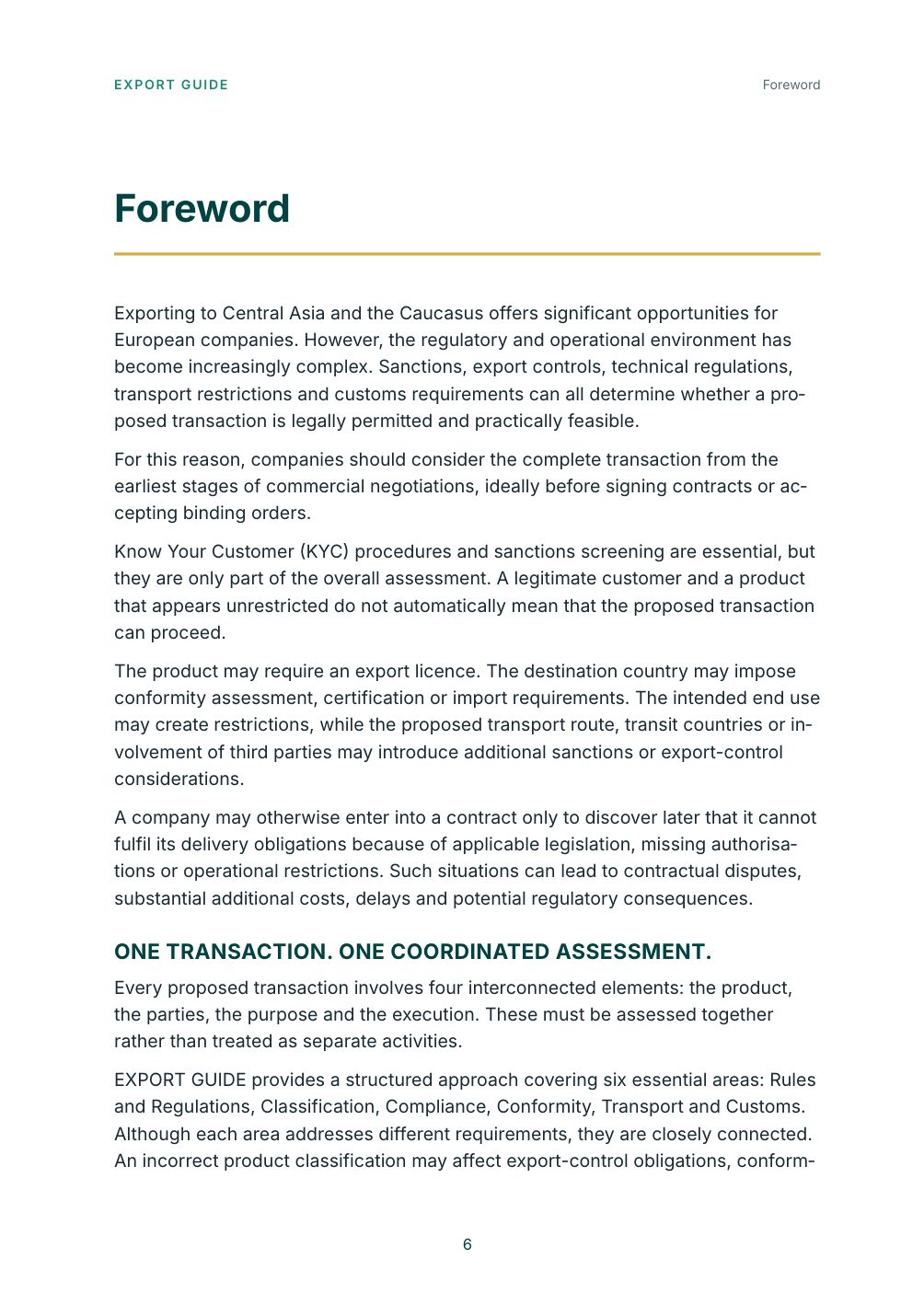
120 pages: a foreword, an introduction to the compliance gap and 9 chapters – Rules and Regulations, Classification, Compliance, Conformity, Transport, Incoterms® 2020, International Transport Rules and Carrier Liability, The Insurance Gap, and Customs. A product classification intake checklist is included in the appendix.
Kazakhstan, Kyrgyzstan, Uzbekistan, Tajikistan, Turkmenistan, Armenia, Georgia and Azerbaijan. It includes country comparisons for certification and customs, and a dedicated section on clearing goods in Kazakhstan.
EU exporters and manufacturers – and the sales, logistics, compliance, legal and finance teams who together decide how a transaction is set up. It is written so that everyone involved in an export can work from the same checklist.
The distance between management's intentions and what actually happens. Sales wins the order on EXW, logistics books the cheapest freight, and the goods are reloaded or rerouted outside European control. Everyone does their job, but nobody controls the whole transaction. The guide shows how to close that gap.
Yes. It explains EU sanctions and dual-use controls, the UK framework and the U.S. rules (EAR, ITAR and OFAC sanctions), how to determine which rules apply to your company and transaction, and the contract clauses that make the controls work in practice.
Yes. It goes through all 11 Incoterms® 2020 rules and where risk passes, compares carrier liability under CMR (road), CIM/SMGS (rail), Hague-Visby (sea) and the Montreal Convention (air) with approximate euro amounts, and explains who actually insures the goods.
Carsten Skov, a senior consultant in trade facilitation, logistics and market access with more than 30 years of experience across Central Asia, the Caucasus, the CIS and Eastern Europe. Read more about the author.
The price is €99 excluding VAT, one-time. VAT is calculated at checkout based on your company details; EU businesses with a valid VAT number are invoiced with reverse charge. Private persons can also buy: choose "Private person" in the order form – private buyers in the EU pay 9% Estonian VAT (€107,91 in total), outside the EU no VAT. You receive a paid invoice by email. See our Terms of Sale and Privacy Policy (PDF).
As soon as your payment is confirmed, a personal download link to the PDF is sent to your email. The link is valid for 7 days, and the PDF can be read on your computer, tablet or phone. Please check your spam folder if it does not arrive within a few minutes.
Yes. A company purchase covers internal use by your own employees. For training, multi-user or corporate licences, please contact us.
The guide is current as of October 2026. Sanctions, export controls and customs rules change often, so each chapter lists the official sources used – making it easy to check the latest version before you ship.
No. Export controls and sanctions change, and the requirements depend on the goods, the parties, the route and the destination. Always confirm the current rules. If you need help with a specific export, Carsten offers training, webinars and one-to-one advice – see the author section.